
PROPERTY NFT MINT · PAID IN GOLD
A thousand lots in the world of Star Forest, fifty of them inside the walls of the capital. Every deed is a real place in the game, with an address, a surveyed plan, a size and its rights. You can't buy one with money. You earn the gold in the game, and the first player to pay for a deed gets it.
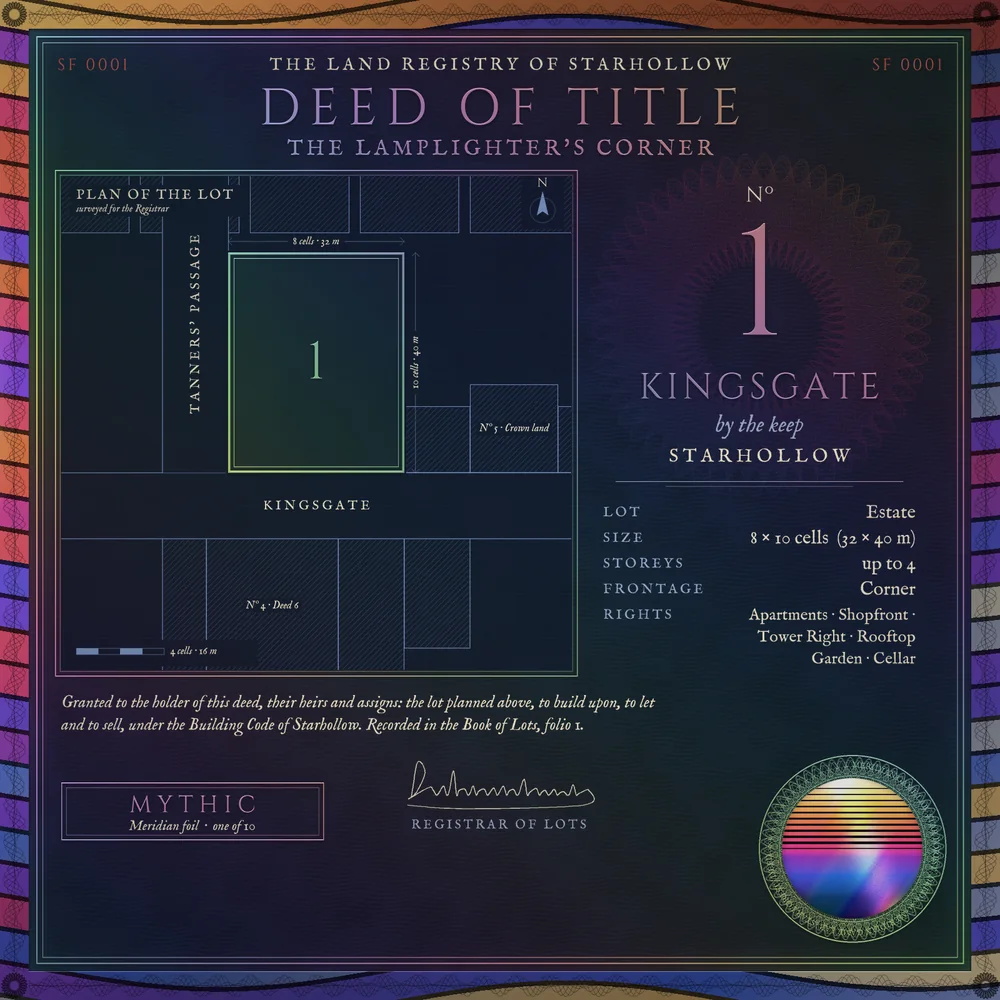
HOW TO READ A DEED
This is deed 531: a house on Basalt Row, in the Citadel Ward of Ashenhold, on the Dark side of the world. Every one of the thousand is drawn the same way, from the same register.
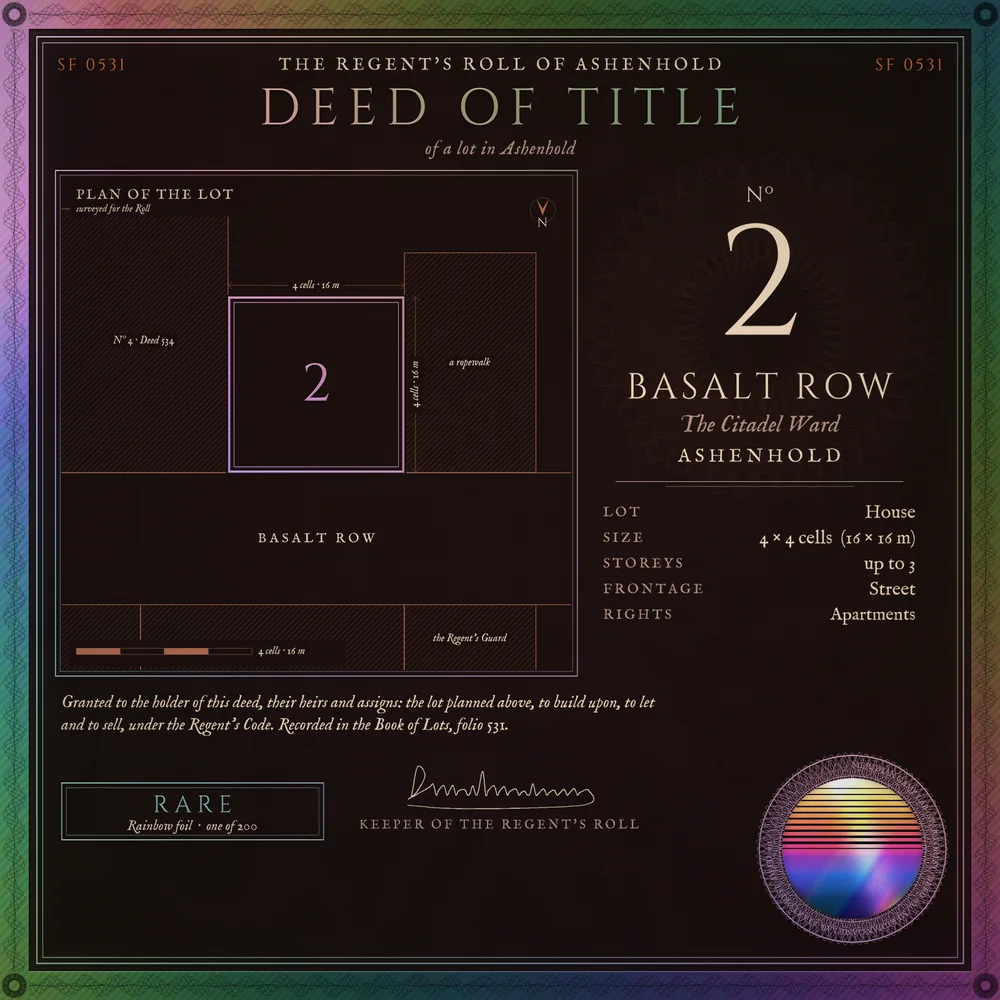
Surveyed from one street plan of the whole world. The plots beside yours are other deeds and the town's own buildings, and two deeds on the same street always agree. The towns are laid out to match.
A number on a named street, in a district and a region. Fifty addresses are inside Starhollow's walls; the rest run from the harbour and the villages of the Light to Ashenhold and the Scorch on the Dark.
Its footprint in build cells (a cell is about 0.9 metres), the storeys that may stand on it, its frontage (street, corner, waterfront, square…) and the rights that come with it.
What the holder may do: build on the lot, let it and sell it, under the town's building code. Recorded in the Book of Lots under the deed's number.
Rarity is the foil: Meridian, Starfall, Cracked Ice, Rainbow, Verdigris or Silver Leaf. Fixed in the register, and set by the place: every capital deed is Epic or better.
Meridian Game Lab's seal, holographic on every deed. Each deed also draws its own rosette, foil angle, plan and signature, so no two are alike.
FROM GOLD TO YOUR FRONT DOOR
There's no mint to rush, and nothing to buy with money. Every deed is first sold in the game, for gold, to the first player who can pay for it. Deeds go on sale a few at a time, on days announced on Discord first. The first sale opens soon.
Gold comes from playing: quests, fights, the mines and the market. It's slow to earn, so every deed's first holder is someone who put the time in.
Each deed is sold for gold at the Registrar in the Hall of Deeds in Starhollow. First come, first served: the first player to pay holds the lot, and once a deed is taken, it's gone.
The deed is issued to your game account, and the lot is yours to build on at once. A week later, a letter in your in-game mail brings your claim link.
Open the link on playstarforest.com, sign in, connect a Solana wallet (Phantom, Solflare or Backpack) and sign one message. The deed is minted straight to your wallet, and we pay the fee. Claiming is optional: you never need a wallet to play or to build.
A claimed deed can be sold on the open market. Meridian Game Lab, the studio that makes Star Forest, receives 5% of each marketplace sale, for good. Bought one? Link your wallet on playstarforest.com, and the lot, with what stands on it, comes to your game account.
Whoever holds the deed builds on the lot in the game: a house, flats, a shop, a garden, or all of them. The land is yours to do with as you wish, within its storeys and the town's building code.
YOUR LAND, YOUR TERMS
A lot can hold more than one player's work. A holder can let others build on their land, or rent them a home or a shop on it, under a land contract signed in the game.
Holder and tenant agree the terms at the Hall of Deeds: what's let (a flat, a shopfront, a corner to build on), the rent in gold, and for how long.
The game holds both sides to it. Rent moves in gold each month on its own, up to three months ahead. A tenant who stops paying gets a week's grace, then loses the key, and a holder can't lock out a tenant who pays.
A contract is written against the deed itself. If the deed changes hands, tenants keep their leases and their keys, and the rent goes to the new holder.
Contracts are optional. A holder who wants the whole lot to themselves never has to sign one.
THE BUILDING CODE
Every town has a building code: what may stand, how tall, how it meets the street, and that it's finished and kept up. It's there so nobody can squat on a lot, or wreck one, and spoil the town for everyone else. Every new holder gets 30 days to build before the first inspection (60 outside the capital). After that, a lot that breaks the code goes down this ladder, a week a step:
The holder gets a letter, and a notice goes up on the lot: what's wrong, and a week to put it right.
Three warnings, a week apart, each with a gold fee: 1%, then 3%, then 5% of the deed's price. Fixing the lot ends it at any step.
After the last warning, a person at Meridian Game Lab walks the lot. Only if they propose it, and a second person hears any appeal, is the deed revoked and its token burned.
A fresh copy of the deed goes back on sale at the Registrar, for gold, first come, first served, the same way the first one was sold.
AppealsAny notice, fee or revocation can be appealed at the Hall of Deeds, where the magistrate hears it, and an appeal stops the clock. Damage from a raid never counts against a lot for a week, so nobody can wreck a rival's house to cost them their deed. Revoking a deed is the last resort, and it's rare.
WHAT A LOT LETS YOU DO
Every lot can hold a house, flats, a shop and a garden, in any mix, up to its storey limit. The rights on a deed add more. How many of the thousand carry each one:
This is building in Star Forest today: a castle raised piece by piece, in first person, from foundations to the roof. On a deed's lot you build the same way, up to the storeys your deed allows.
Let as many flats as your building holds, each with its own door and lock.
A counter on the street that keeps selling while you're away.
Build above your storey limit with tower pieces, up to eight storeys: the tall, narrow, cone-roofed kind.
Soil on your roofs and terraces, so crops grow above the street.
Dig one storey below the street, for stores, a workshop or a quiet way in.
A berth at your lot's edge of the water, where your boat waits.
THE GAME'S ECONOMY
Deeds plug into the gold economy every player already uses. Holders become landlords, shopkeepers and hosts, and the players who rent from them are why it matters.
STARHOLLOW · THE FOUNDING CHARTER
Deeds 1 to 50 are the capital, and every one of them is Epic, Legendary or Mythic. Starhollow is being rebuilt around them: denser, taller, its streets shoulder to shoulder, in six wards.
WHY THESE ARE DIFFERENT
Each deed is a surveyed lot on a named street, and its art is that street's plan. What the deed says is what the game builds: the footprint, the storeys, the rights.
All thousand plans come from one street layout. Neighbouring deeds show each other, corners face real cross streets, the river runs behind the right side of the street.
Every deed's first holder paid for it in gold they earned by playing. Nobody gets a lot first because they had money to spend.
Star Forest is free. You never need a deed to play it. A deed gives you a place in the world, and a part in the game's economy.
SIX FOILS
Rarity is fixed, and it's printed: each tier has its own holographic foil. The ribbons below are cut from the deeds' own borders.
| Rarity | Foil | Deeds | In the capital | Where |
|---|
THE BOOK OF LOTS
Every deed in the collection, as it will be sold. Open one to see its whole record.